
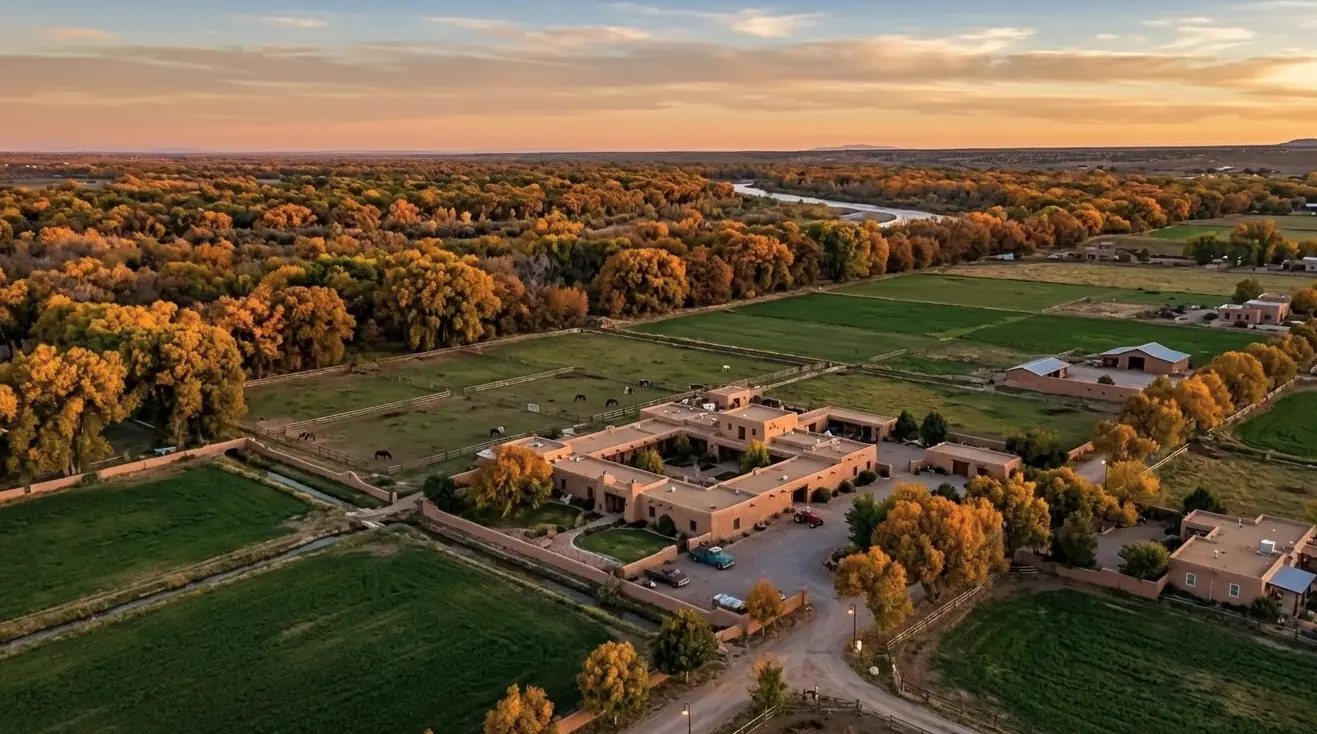
If you’ve ever driven through Corrales on a fall afternoon — past apple orchards and chile farms, horses grazing behind adobe walls, the Sandia Mountains glowing pink to the east — you understand immediately why homes here sell fast and for top dollar. Corrales is the rare place where “small town” isn’t a euphemism for “limited” but a genuine description of a place that has figured out exactly what it wants to be.
What Is Corrales?
Corrales is an incorporated village of about 10,000 residents situated between the Rio Grande and the West Mesa, north of Albuquerque and just south of Rio Rancho. It’s not a neighborhood of Albuquerque — it’s its own municipality, with its own village government, police department, and fiercely protective development standards. That independence is exactly why Corrales has retained its character while everything around it has changed.
The village limits sprawl is by design. Corrales has consistently resisted commercial development and subdivision-style housing in favor of its agricultural zoning, which requires minimum lot sizes of one acre in most areas. The result is a community where neighbors are counted in the hundreds per square mile, not thousands, and where the landscape still looks more like 1950s New Mexico than 2025 suburbia. Nearby North Valley shares some of this character, but Corrales takes it further with stricter village-level controls.
Corrales Housing Market
Corrales real estate is not for budget shoppers — the combination of large lot requirements, limited supply, and intense demand from buyers across the metro keeps prices elevated. But for what you get — an acre or more, agricultural rights, a village that actively protects your investment from encroaching sprawl — the premium is defensible.
- Smaller homes on 1-acre lots: $450,000–$650,000
- Mid-range (updated, 1–2 acres, 3–4BR): $650,000–$950,000
- Premium properties (horse facilities, larger parcels, custom): $950,000–$2,500,000+
- Days on market: Desirable properties often receive multiple offers within days
- Rental market: Very limited rental inventory; 3BR homes when available: $2,200–$3,500/month
Inventory is chronically low. Corrales homeowners tend to stay put for decades, so turnover is slow. When a well-positioned property does hit the market, buyers from Ventana Ranch, North Albuquerque Acres, and even Santa Fe compete. Come pre-approved, come ready to move quickly, and work with an agent who knows the village well.
Schools in Corrales
Corrales sits within the Rio Rancho Public Schools district — one of the highest-rated school districts in New Mexico. Corrales Elementary School is the village’s own campus and has an excellent reputation. Middle and high school students typically attend Rio Rancho public schools, which consistently outperform the statewide average.
Corrales International School, a dual-language immersion charter, draws students from across the West Side and Corrales itself. It’s a popular option for families who want Spanish-English bilingual education in a rigorous academic environment. Given Corrales’s demographics — many professional and arts-world families — school involvement tends to be high.
Lifestyle in Corrales
Corrales operates on its own rhythm. The Corrales Growers’ Market on Sundays is a village institution, drawing farmers, artisans, and food producers from across the region. Apple orchards along Corrales Road sell direct in the fall. The Acequia del Bosque runs through the village and the annual acequia cleaning is a communal event that connects residents to centuries of New Mexico water history.
The Corrales bosque trail system connects to the larger Rio Grande trail network, offering miles of equestrian, cycling, and walking paths. Several art galleries operate out of historic adobes along Corrales Road. Casa San Ysidro — a museum of historic New Mexico architecture — sits within the village. The local restaurants, though few in number, punch well above their weight: Casa Vieja and Indigo Crow have loyal followings across the metro.
Pros & Cons of Living in Corrales
- Pro: Genuine agricultural village character protected by village zoning
- Pro: Large lots (typically 1+ acre) with horse rights
- Pro: Excellent Rio Rancho school district
- Pro: Strong community identity and engaged residents
- Pro: Historically strong property value appreciation
- Con: High entry price — one of the most expensive markets in the ABQ metro
- Con: Very limited inventory — sometimes months between suitable listings
- Con: No major retail in the village; shopping requires driving to Rio Rancho or ABQ
- Con: Strict village codes limit what you can build or modify
Sherlock’s Verdict
Corrales is genuinely special — the kind of place that serious buyers research for years before a property finally aligns with their budget and timeline. If you have the resources and patience, it’s worth the wait. For buyers on a tighter budget who love the Corrales lifestyle, look at the northern portions of the North Valley or explore what Alameda has to offer. Sherlock Homes NM actively monitors Corrales inventory — reach out and we’ll alert you the moment something right comes available.
Frequently Asked Questions
Is Corrales part of Albuquerque or Rio Rancho? Neither — Corrales is its own incorporated village within Sandoval County. It has its own mayor, village council, and police department.
Can you have horses in Corrales? Yes — most of Corrales is zoned for agricultural use including horses. It’s one of the primary reasons buyers seek properties here.
How far is Corrales from downtown Albuquerque? About 20–25 minutes in normal traffic via Coors Blvd and I-40, or via Paseo del Norte. Commute to Rio Rancho is under 15 minutes from most Corrales addresses.