
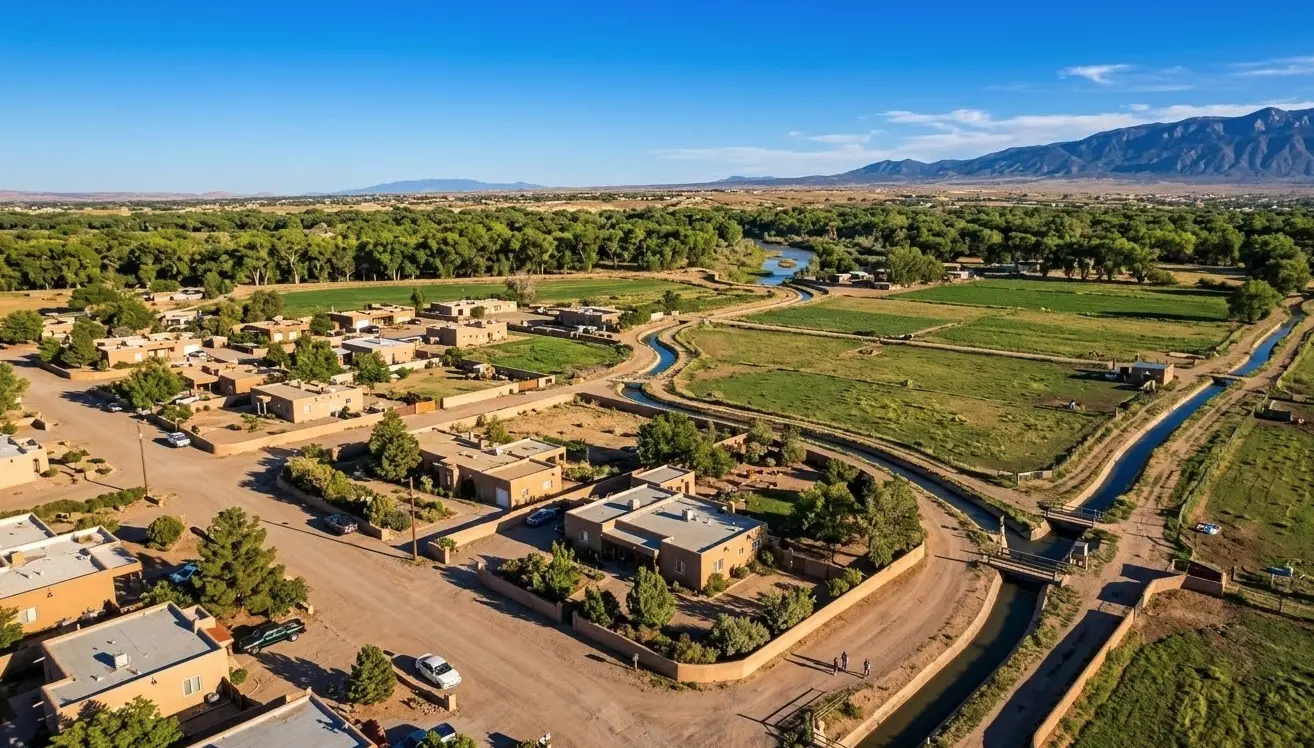
Dallas has transformed from an affordable Texas alternative to a legitimately expensive metro over the past decade. The DFW Metroplex now commands home prices that would have been unthinkable in 2015, with property taxes that offset Texas’s no-income-tax advantage significantly. Albuquerque sits 600 miles west on I-40 and offers a genuinely different proposition: lower housing costs, lower property taxes, dramatic mountain scenery, and a Southwest culture that’s distinct from the Sun Belt sprawl of North Texas. Here’s the honest comparison.
Housing: The Core Comparison
Dallas metro (DFW) median home prices have climbed to the $420,000–$480,000 range heading into 2026, with popular suburbs like Frisco, Plano, and McKinney frequently hitting $500,000–$650,000 for newer construction. Albuquerque’s metro median sits at $335,000–$360,000 — a savings of $80,000–$145,000 on median comparisons, and often more when comparing specific neighborhood types.
What that savings buys in ABQ: in the $400,000–$500,000 range, Albuquerque offers foothills homes in Sandia Heights or High Desert with Sandia Mountain views, master-planned community amenities, and trail access from your door. In Dallas at that price point, you’re in a distant suburb competing with new construction that often feels generic and lacks geographic character.
Property Taxes: Where ABQ Wins Decisively
Texas has no state income tax, but it compensates with some of the highest property taxes in the nation. Effective property tax rates in the DFW area run 1.8–2.5% of assessed value depending on the municipality and school district. On a $450,000 Dallas home, that’s $8,100–$11,250/year in property taxes — every year, compounding as the assessed value rises.
New Mexico’s effective property tax rate in Bernalillo County runs 0.7–0.9%. On a $350,000 ABQ home: $2,450–$3,150/year. The annual property tax savings of $5,000–$8,000+ can offset most or all of the New Mexico state income tax that Texas residents don’t pay. For many households, the net tax burden is comparable or lower in ABQ despite NM’s income tax, once property taxes are factored in.
Traffic and Commute
Dallas traffic is a genuine quality-of-life problem. The DFW Metroplex spans over 9,000 square miles and is built around car dependency, with highway systems that are perpetually under construction and rush hours that stretch from 7–9 AM and 4–7 PM on the major corridors (I-635, I-35E, I-75, US-75, I-30). Average DFW commute times rank among the worst in the Sun Belt.
Albuquerque’s traffic is dramatically more manageable. Rush hour exists on I-25 and I-40 but rarely creates the multi-hour delays common in DFW. Most ABQ commutes run 15–30 minutes. The city is compact enough that workers typically live close to employment centers. The mental health benefit of not spending 45–90 minutes in daily traffic is real and significant.
Climate: Heat Without Humidity vs. Mountain Desert
Dallas summers are hot and humid — 95–100°F with meaningful humidity creates heat index values that make outdoor activity uncomfortable or dangerous in July and August. The infamous Texas ice storms of recent winters (2021 especially) revealed infrastructure vulnerability to cold that ABQ simply doesn’t share.
Albuquerque’s summers are comparably hot (95–100°F) but dramatically drier — the desert heat is more tolerable than Dallas’s humidity-laden version, and evenings cool into the 60s–70s routinely. The July–September monsoon season brings afternoon thunderstorms that provide genuine relief. Winters are mild: occasional light snow, cold nights, but nothing approaching a Texas ice storm scenario. The Sandia Mountains — visible from almost everywhere in the city — provide a constant scenic backdrop that flat North Texas simply cannot offer.
Schools and Family Life
DFW has strong suburban school districts — Frisco ISD, Plano ISD, and Southlake Carroll are nationally recognized. This is a genuine Dallas advantage that ABQ cannot fully match at a metro-wide level. Albuquerque Public Schools has strong individual schools and highly-regarded magnet programs, but the overall system is more variable than DFW’s top suburban districts.
That said, specific ABQ neighborhoods offer excellent school quality. The Academy Hills and Hoffmantown areas feed into consistently strong APS schools. High Desert feeds La Cueva High School, one of NM’s top-ranked. Families who research the specific school zones in their target ABQ neighborhoods typically find quality comparable to mid-tier DFW suburbs.
Outdoor Recreation: No Contest
Dallas’s outdoor recreation options are limited by geography — the DFW area is flat, and meaningful hiking, mountain biking, or skiing requires hours of driving. Lake recreation (Lake Lewisville, Lake Texoma) is the primary outdoor option for most DFW residents.
Albuquerque’s outdoor recreation is a defining lifestyle advantage. The Sandia Mountains rise 10,378 feet immediately east of the city, offering hiking, mountain biking, and skiing accessible within 30 minutes of most ABQ neighborhoods. The Rio Grande bosque trail system runs the length of the city. Taos Ski Valley and Santa Fe are 90 minutes away. For active households who had to drive to Colorado for meaningful mountains from Dallas, ABQ’s proximity to world-class outdoor recreation is a genuine lifestyle transformation.
Final Thoughts
Dallas vs. Albuquerque isn’t a perfect trade — DFW’s larger economy, stronger school districts, and no-income-tax status are real advantages. But ABQ wins on housing affordability, property taxes, traffic, outdoor recreation, and climate quality for active households. For DFW residents whose lifestyle is compatible with a smaller, mountain-adjacent city, the financial and lifestyle case for ABQ is strong. Sherlock Homes NM helps Dallas transplants find the right Albuquerque neighborhood — reach out to start the comparison on your specific situation.