
Arizona and New Mexico share a border, a desert climate, and a Southwestern character — but they’re more different than most people expect. If you’re relocating from Arizona to New Mexico, this guide cuts through the generalizations and gives you the specific intel you need to land well in Albuquerque.
Why Arizona Residents Are Moving to New Mexico
The Arizona-to-New Mexico pipeline runs strong for a few clear reasons. Arizona’s population boom — particularly in the Phoenix metro — has pushed housing prices, traffic, and competition for jobs to levels that wear people out. New Mexico, and Albuquerque specifically, offers comparable sunshine and desert scenery with lower home prices, less congestion, and a more manageable city scale.
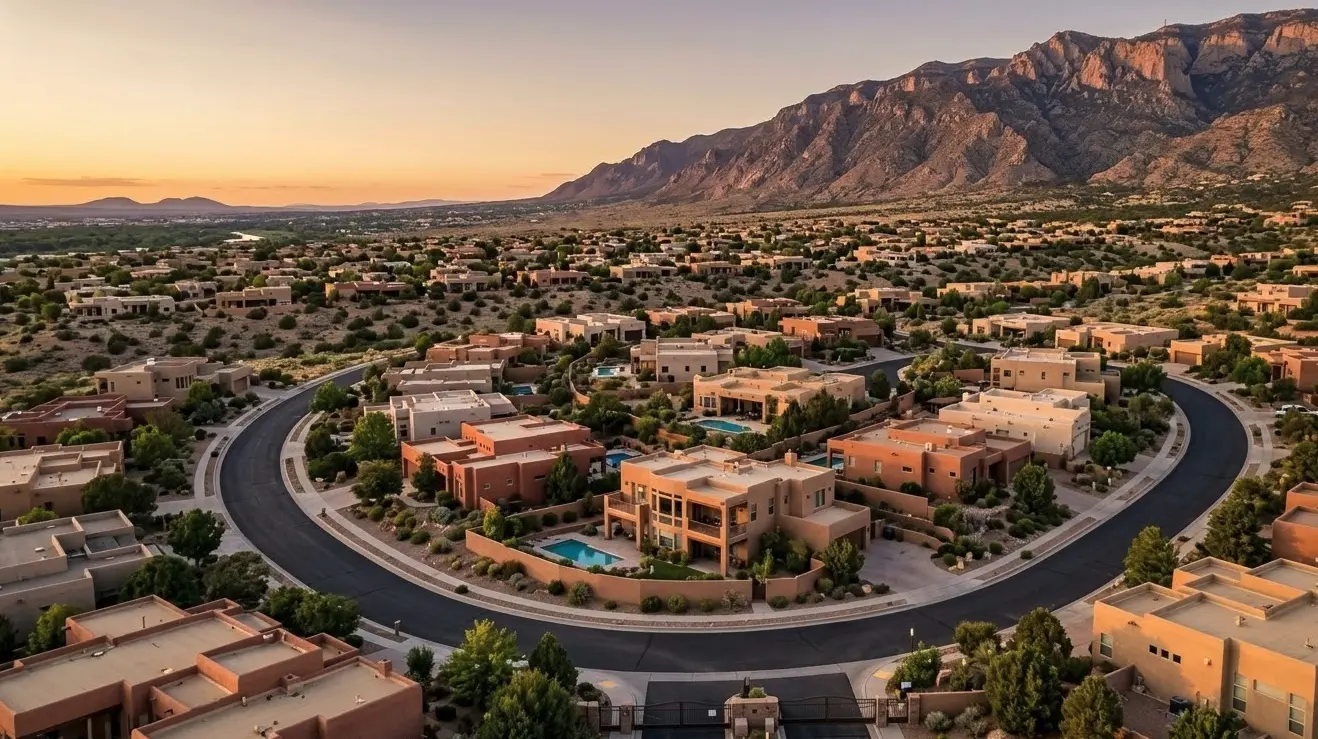
There’s also a quality-of-life dimension. Albuquerque’s position at 5,300 feet means summers are genuinely tolerable — highs in the low 90s rather than Arizona’s triple-digit punishment. The Sandia Mountains rising 10,678 feet just east of the city give the urban landscape a drama that flat Phoenix metro simply can’t match.
Housing Market: What Your Arizona Budget Buys
Housing is the strongest argument for the Arizona-to-ABQ move. While Phoenix-area medians have climbed past $400,000 and Tucson has followed suit, Albuquerque’s median sits in the $290,000–$330,000 range. That gap lets Arizona equity go further.
In the northeast, neighborhoods like Taylor Ranch and Paradise Hills offer established single-family homes in the $220,000–$350,000 range — roomy, well-maintained, with good access to I-25 and Paseo del Norte. For buyers who want newer construction, Northern Meadows in the far northwest delivers modern builds with HOA amenities at prices well below comparable Phoenix suburbs.
Luxury buyers from Scottsdale or Paradise Valley will find their niche too. High Desert and Tanoan in the northeast offer gated communities, custom builds, and golf-course living with Sandia Mountain views — typically $500,000–$900,000+.
Taxes and Finances: The Full Picture
New Mexico’s tax structure differs from Arizona’s in ways that matter for relocation planning:
- Income tax: NM uses a graduated rate topping at 5.9% for income over $210,000. Arizona moved to a flat 2.5% — NM is higher for most earners.
- Property tax: NM’s effective rate (~0.55%) is lower than Arizona’s (~0.66%), and NM’s low home values amplify the savings.
- Sales tax: NM’s gross receipts tax varies by municipality; Albuquerque is around 7.875%, comparable to most Arizona cities.
- Social Security: New Mexico taxes Social Security income (with exemptions); Arizona does not. Retirees should model this carefully.
For working-age households, the higher income tax is real but often offset by housing savings. Run your specific numbers before dismissing the move on tax grounds alone.
Jobs and Economy
New Mexico’s economy is smaller than Arizona’s and more concentrated in government, defense, and healthcare. Kirtland Air Force Base and Sandia National Laboratories anchor a significant federal presence. The University of New Mexico and UNM Hospital are major employers. Intel’s manufacturing campus in nearby Rio Rancho adds a tech-industrial dimension.
For Arizona transplants who work remotely, the economic calculus is simpler: your income follows you, and your cost of living drops. New Mexico has been active in courting remote workers, and Albuquerque’s downtown is seeing genuine tech-sector growth around the Innovate ABQ campus and Central Avenue corridor.
Culture Shift: From Arizona to New Mexico
Both states share Southwestern identity, but New Mexico’s runs deeper and stranger in the best way. The state’s tri-cultural heritage — Native American, Hispanic, and Anglo — layers history onto every street name, neighborhood, and meal. Old Town Albuquerque has been continuously inhabited since the early 1700s. Acequias — Spanish-era irrigation ditches — still flow through the North Valley.
Green chile is a religion. Hatch green chile season each fall brings a ritual that Arizona’s salsa culture simply doesn’t replicate. Balloon Fiesta in October fills the sky with hundreds of hot air balloons over the Rio Grande — it’s unlike anything else in the country.
Practical Moving Tips for Arizona Transplants
- Vehicle registration: New Mexico requires an emissions test and VIN inspection; budget time for the MVD process.
- Altitude: Coming from Phoenix (1,100 ft) or Tucson (2,400 ft) to ABQ (5,300 ft), expect 1–2 weeks of adjustment. Hydrate more than you think you need to.
- Driver’s license: Update within 90 days of establishing residency.
- Home cooling: Swamp coolers (evaporative cooling) are common in ABQ and highly effective at this altitude and humidity level — don’t assume you need central AC.
Final Thoughts
Relocating from Arizona to New Mexico is a lateral move geographically but a meaningful upgrade in affordability and quality of life for many households. The trade-offs are real — a smaller job market, higher income taxes for some, and a slower pace. But for those who value authentic culture, mountain access, and a city that hasn’t yet been discovered by everyone, Albuquerque delivers. Ready to explore your options? Sherlock Homes NM knows every corner of the ABQ market — let’s find your neighborhood.