
Denver has been one of the country’s most sought-after cities for over a decade — but the cost of living has caught up with the appeal. If you’re among the growing number of Colorado residents eyeing Albuquerque as an alternative, you’re not alone. ABQ has been absorbing Denver transplants at a steady clip since 2020, and for good reason: the distance is manageable, the cultures are compatible, and your housing dollar goes dramatically further. Here’s everything you need to know about moving to Albuquerque from Denver.
Why Denver Residents Are Choosing Albuquerque
The math is straightforward. A home that costs $650,000 in Denver’s metro area can be replicated in quality and character in Albuquerque for $350,000–$450,000. For Colorado homeowners sitting on substantial equity from the Denver boom, that gap means arriving in ABQ either debt-free or with a much smaller mortgage — and a dramatically lower monthly payment. The 450-mile drive down I-25 is a straight shot, and flights between the two cities run under an hour, keeping ties to Colorado easy to maintain.
Beyond housing, Albuquerque offers the mountain proximity and outdoor culture that Denver residents love — the Sandia Mountains provide a dramatic eastern backdrop, hiking is abundant, and skiing at Ski Santa Fe and Taos Ski Valley is within 90 minutes. The climate is sunnier and drier than Denver (though ABQ’s elevation of 5,300 feet means it does get real winters, just milder ones).
Cost of Living: Denver vs. Albuquerque
The cost of living difference between Denver and Albuquerque is significant across most categories:
- Housing: ABQ median home prices ($335K–$360K) are roughly 40–50% below Denver metro medians ($560K–$620K). Rent differentials are similarly substantial — a 2-bedroom apartment that runs $2,200–$2,800/month in Denver rents for $1,200–$1,700 in Albuquerque.
- Property taxes: New Mexico’s effective property tax rates (0.7–0.9% in Bernalillo County) are well below Colorado’s (0.5–0.8% in metro Denver) — a smaller difference than many expect, but NM’s lower assessed values make the actual dollar amount much lower.
- State income tax: New Mexico’s top income tax rate is 5.9%; Colorado’s flat rate is 4.4%. NM taxes more at higher incomes, but the housing savings typically far outweigh the tax difference for most transplants.
- Groceries, dining, services: Generally 10–20% lower in Albuquerque across most categories.
Neighborhoods Denver Transplants Love
Knowing where to look in Albuquerque makes the transition much smoother. Colorado transplants tend to cluster in a few specific areas that match their lifestyle expectations:
Northeast Heights / Foothills: If you’re coming from Denver’s Highlands, Cherry Creek, or Stapleton, you’ll feel at home in Northeast Heights. High Desert in particular — a master-planned foothills community — draws comparisons to Denver’s better planned subdivisions. Mountain views, trails, and newer construction in a range from $450K to $900K+.
Nob Hill: Denver’s Capitol Hill and Baker neighborhood transplants often gravitate toward Nob Hill — walkable, eclectic, with independent restaurants and coffee shops on Central Ave. Homes here are smaller but the neighborhood character is strong.
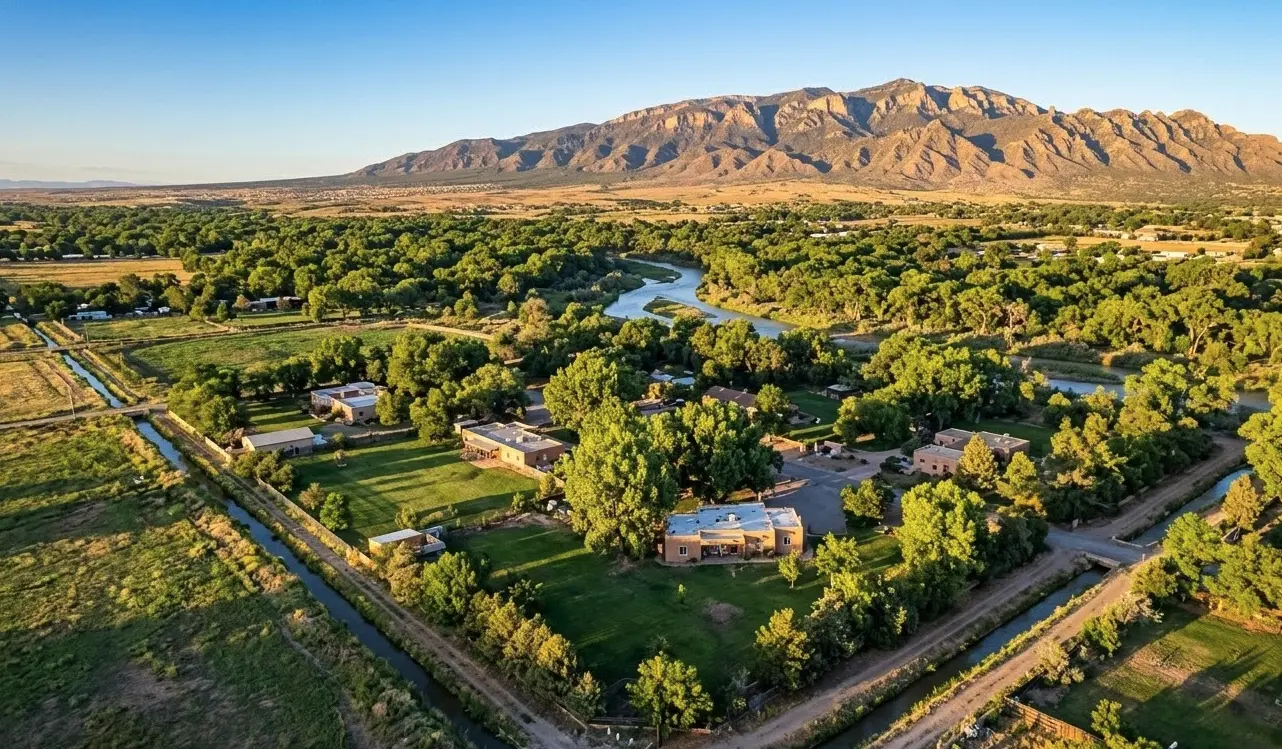
North Valley: If you’re coming from Denver’s Wash Park area or the semi-rural Jefferson County foothills and want land, mature trees, and proximity to nature, North Valley delivers. The Rio Grande bosque is a legitimate substitute for Denver’s parks system, and horse properties here are a fraction of the Colorado price.
Corrales: For the Colorado buyer who wants the lifestyle of an Erie or Longmont-style semi-rural community but with serious character — old cottonwoods, vineyards, the acequia culture — Corrales is the answer. A 30-minute commute to Albuquerque proper.
Job Market: What to Know Before You Go Remote or Job Hunt
Albuquerque’s job market is smaller than Denver’s, with a different profile. The major employers are anchored in government, defense, healthcare, and education: Kirtland Air Force Base, Sandia National Laboratories, the University of New Mexico, UNMH, Lovelace Health, and Presbyterian Healthcare. Intel’s fab facility in nearby Rio Rancho is a significant private employer.
For Denver transplants in tech, finance, or professional services, the most common path is remote work. ABQ is increasingly a remote-work destination precisely because the cost savings are real and the quality of life is high. If you’re tethered to in-person work, research your specific sector carefully — ABQ has less depth in corporate tech and finance than Denver, but growing capability in aerospace, cybersecurity, and renewable energy.
Climate and Lifestyle Adjustments
Albuquerque gets 310+ sunny days per year — more than Denver’s already-sunny 300. Summers are hot (highs in the 95–100°F range in July/August) with the monsoon season arriving in July, bringing afternoon thunderstorms that cool things dramatically. Winters are milder than Denver’s — ABQ rarely sees the sustained cold or heavy snowfall that hits the Front Range, though light snow a few times a year is normal at 5,300 feet elevation.
Cultural adjustment notes for Denver transplants: Albuquerque is a majority-minority city with deep Hispanic and Native American heritage. The food culture — green chile on everything, sopapillas, red or green (or Christmas!) — is distinct and beloved. The city is smaller, the pace is slower, and the infrastructure less polished than Denver’s, but that’s partly what keeps it affordable and genuine.
Practical Relocation Tips
- Time your home sale: Colorado’s spring market (March–June) is strong for sellers. Lining up your Denver sale with an ABQ purchase takes coordination but maximizes your equity extraction.
- Visit first, thoroughly: ABQ’s geography is disorienting at first — the mountains are always east, which helps orient you. Spend a long weekend in different quadrants before deciding where to focus your search.
- NM driver’s license and plates: Required within 90 days of establishing residency. NM vehicle registration includes an excise tax that can be significant for newer vehicles — factor it in.
- Green chile protocol: At every restaurant, you will be asked “red or green?” Answer “Christmas” for both. You’re welcome.
Final Thoughts
Moving to Albuquerque from Denver is a decision that works financially for most Colorado transplants who make the move — lower housing costs, comparable outdoor lifestyle, and a genuine sense of place that feels increasingly rare. The Sherlock Homes NM team has guided multiple Colorado buyers through the process of finding and purchasing the right home in Albuquerque. Reach out to start your investigation into which ABQ neighborhood fits the life you’re building.