
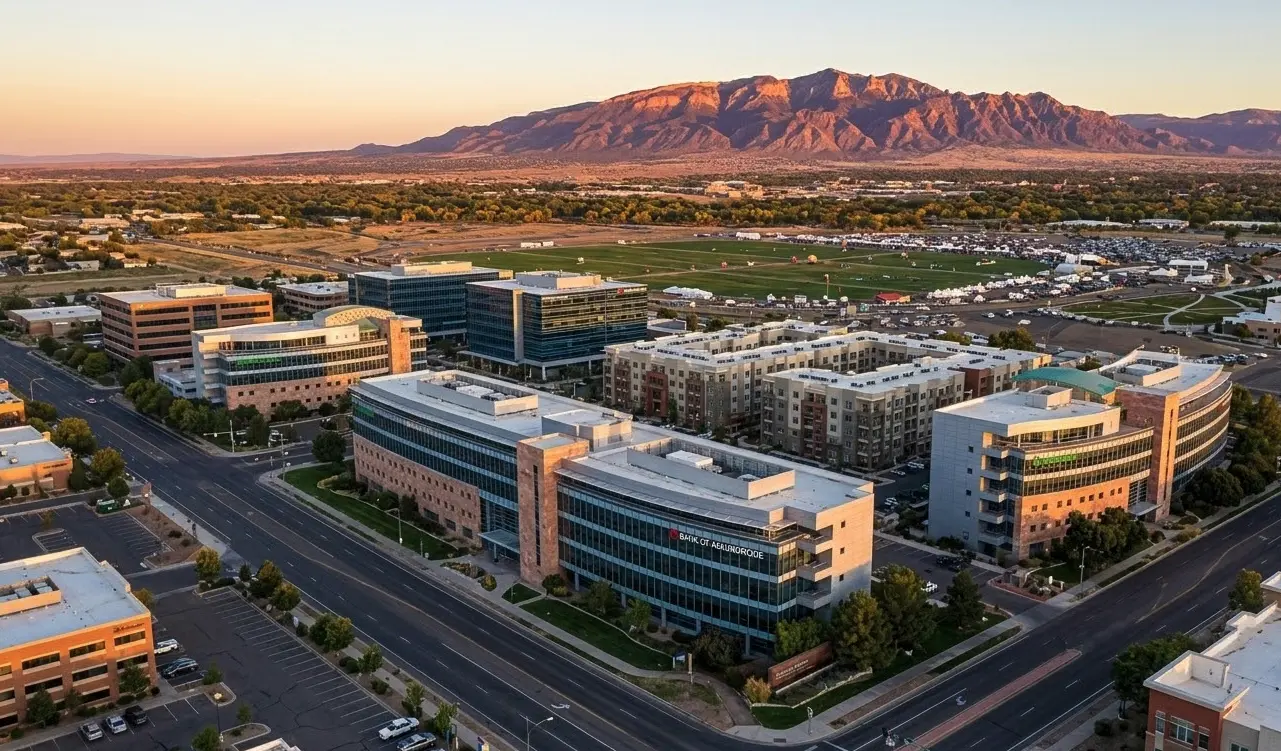
New Mexico’s real estate market in 2026 sits at an interesting inflection point — post-pandemic normalization is mostly complete, interest rates have settled into a new higher-for-longer equilibrium, and the state’s economic fundamentals tell a nuanced story of growth in some sectors and persistent challenges in others. Whether you’re buying in Albuquerque, investing in Santa Fe, or watching the market from the sidelines, here’s what the signals suggest for New Mexico real estate through the rest of 2026. Note: this is editorial analysis and projection, not guaranteed data. Always verify with a licensed professional before transacting.
The Macro Backdrop: Rates, Jobs, and Migration
Three forces dominate the New Mexico real estate outlook for 2026:
Interest rates: The Federal Reserve’s gradual easing cycle has brought 30-year mortgage rates from the 7.5–8% peaks of late 2023 down to the 6–6.75% range. Further cuts are possible but not guaranteed — the baseline assumption for 2026 planning should be rates holding in the 6–7% band. At these levels, monthly payments on a median NM home run roughly $2,000–$2,400/month (principal and interest on a 5% down purchase), which is manageable for dual-income households but a stretch for single earners at median wages.
Employment: New Mexico’s economy has several anchors that provide stability: federal government and military presence (Kirtland AFB, Sandia National Labs, Los Alamos National Lab), the University of New Mexico and its medical complex, and a growing technology and renewable energy sector. The state’s unemployment rate has historically run slightly above national averages, but the high-wage anchor employers provide demand support that keeps housing markets in Albuquerque and Santa Fe more resilient than the state’s overall wage picture might suggest.
Migration: Net domestic migration into New Mexico has been positive since 2020, driven primarily by affordability refugees from California, Colorado, and Texas. This trend is expected to continue in 2026, albeit at a more moderate pace than the peak 2021–2022 migration wave.
Albuquerque Forecast: Steady, Modest Growth
For Albuquerque specifically, the 2026 forecast calls for continued modest appreciation in the 3–6% range metro-wide, with significant variation by neighborhood and price tier. The $280,000–$420,000 segment — entry and move-up demand driven by local buyers and in-migrants — is expected to remain the tightest, with the most consistent price support.
Neighborhoods with the strongest fundamentals heading into 2026: Nob Hill (walkability premium), High Desert (master-planned foothills), and the mid-tier Northeast Heights including Academy Estates and surrounding areas (school district quality, established character). These areas are expected to outperform the metro average.
The Westside and Rio Rancho will likely see more modest appreciation given new construction supply competing with resale. However, builder incentive programs (rate buydowns, closing cost credits) may support transaction volume even if headline price gains are lower.
Santa Fe: A Different Dynamic
Santa Fe operates as a separate market from Albuquerque — more heavily influenced by second-home buyers, retirees, and the arts/tourism economy. Median prices in Santa Fe significantly exceed Albuquerque ($500,000+ for the city proper), and the market is more sensitive to national wealth effects (stock market performance, coastal real estate conditions) than to local wage dynamics.
The 2026 Santa Fe outlook is more uncertain than Albuquerque’s. The luxury segment that drives much of Santa Fe activity is sensitive to interest rates and stock market volatility. A positive market year and continued rate easing would support Santa Fe. Conversely, a market downturn could pull back demand from discretionary buyers who aren’t pressed to buy.
Rio Rancho: Growth Market with Caveats
Rio Rancho continues to absorb population growth spilling out of Albuquerque. Intel’s presence and the city’s younger demographic (more families with children than Albuquerque proper) support sustained housing demand. The forecast for 2026: steady transaction volume with modest price appreciation, particularly in the $300,000–$450,000 range where most Rio Rancho activity concentrates.
The caveat: Rio Rancho has more new construction supply than most ABQ submarkets, which moderates price appreciation. Investors should model carefully — cap rates in Rio Rancho are tighter than they were three years ago, and rental growth has slowed.
Key Risks to the Forecast
Any real estate forecast carries uncertainty. The primary risks to the 2026 NM outlook:
- Rate spike: If inflation re-accelerates and the Fed reverses course, pushing mortgage rates back above 7.5%, expect a meaningful demand pullback in the financed buyer market. Cash buyers would remain active but couldn’t absorb all the slack.
- Federal spending cuts: Sandia Labs, Los Alamos, and Kirtland AFB together employ tens of thousands of high-wage workers. Any significant federal budget reduction targeting these facilities would ripple through the ABQ and Santa Fe markets with unusual force, given how concentrated this employment base is.
- Water: New Mexico’s long-term water situation is a structural risk for growth markets, particularly in the Albuquerque metro. Current conditions don’t create near-term housing market stress, but water availability is a factor that will influence long-term growth trajectories, particularly for new development in the outlying areas.
Sherlock’s 2026 NM Real Estate Outlook
Overall: cautiously optimistic for the Albuquerque metro, with Nob Hill and established Northeast Heights as the most defensible investment. North Valley continues to be underappreciated by buyers who overlook the semi-rural character it offers. The Westside offers value and new-construction incentives for buyers prioritizing square footage and modern systems over neighborhood character.
For sellers: the window is open but not unlimited. Spring 2026 is the strongest listing environment of the year — don’t wait for “the market to come back” to pre-2022 frenzy conditions that are structurally unlikely to return at current rates.
Final Thoughts
New Mexico real estate in 2026 is neither the bonanza of 2021 nor the distress of a down cycle — it’s a market that rewards preparation, local knowledge, and realistic expectations. Sherlock Homes NM tracks these dynamics continuously and provides neighborhood-specific guidance that generic forecasts can’t offer. Whether you’re buying, selling, or investing in the Land of Enchantment, reach out to get a read that’s specific to your situation.