
The AZ to NM relocation has become one of the Southwest’s most common moves — and one of the most underplanned. Arizona and New Mexico share a border and a general desert identity, but the logistics, taxes, lifestyle, and housing market are different enough that a little preparation goes a long way. Here’s your practical, step-by-step guide to making the move smoothly.
Step 1: Choose Your Albuquerque Neighborhood
ABQ’s geography divides naturally into quadrants anchored by I-25 (north-south) and I-40 (east-west). Most Arizona transplants end up in the Northeast Heights or Northwest side, where the development patterns feel more familiar. But every corner of the city has something different to offer.
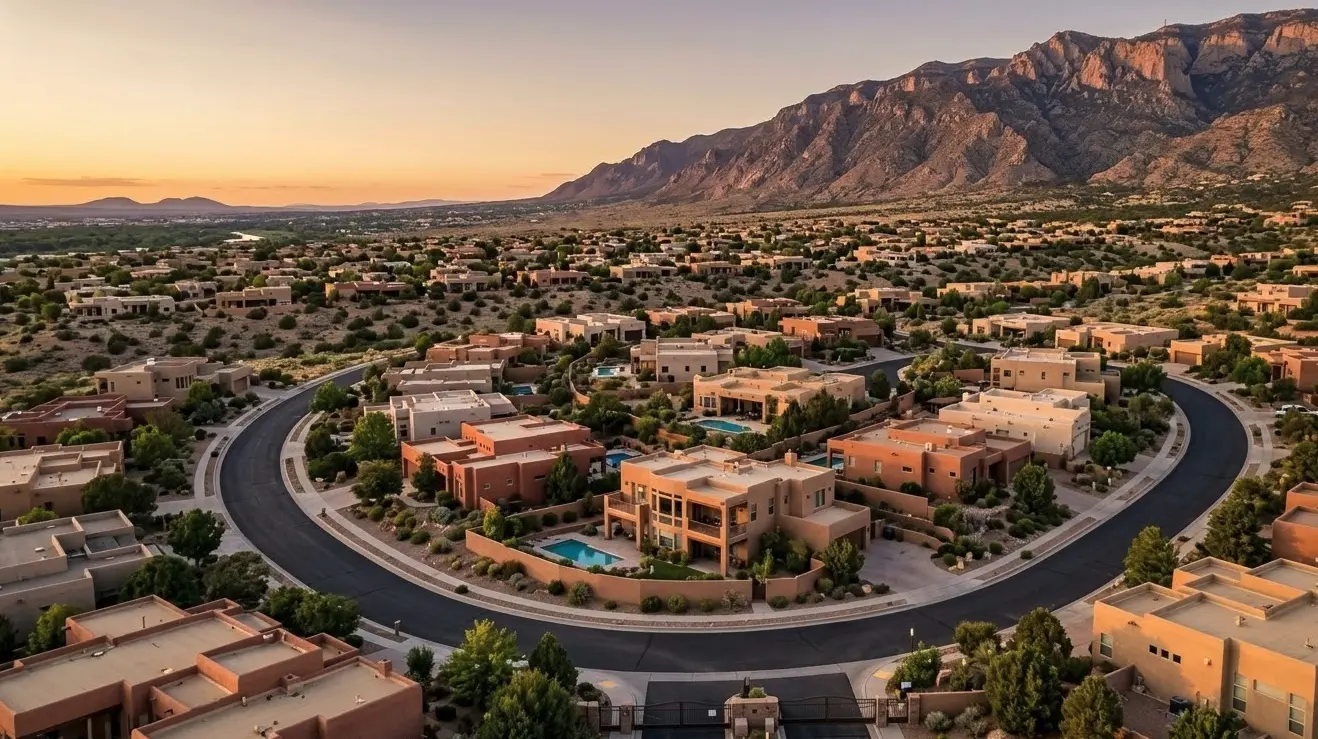
If you’re coming from a master-planned suburb like Gilbert or Chandler, look at Ventana Ranch or Cabezon on the northwest side — HOA communities with newer construction, parks, and amenities. If you want walkability and urban energy, Nob Hill along Central Ave delivers independent restaurants, coffee shops, and a dense neighborhood feel. For mountain proximity and upscale living, High Desert and La Cueva in the northeast back up to the Sandia foothills.
Step 2: Understand the Housing Market
Albuquerque’s market moves at a slower pace than Phoenix-area. You’ll generally have more time to evaluate properties, and bidding wars — while they do happen — are less frenzied than what Arizona buyers have experienced in recent years. Key numbers to know:
- Median home price: ~$290,000–$330,000
- Average days on market: 30–60 days depending on price range
- Down payment assistance: New Mexico’s MFA (Mortgage Finance Authority) offers FirstHome and NextHome programs with down payment grants
- Property tax rate: ~0.55% effective rate — lower than Arizona’s ~0.66%
If you’re selling in Arizona first, coordinate timing carefully — ABQ’s market is active enough that you’ll want pre-approval in hand before you list your AZ property.
Step 3: Plan the Physical Move
The drive from Phoenix to Albuquerque is roughly 470 miles — about 6.5 hours via I-10 east to I-25 north through Truth or Consequences. From Tucson it’s about 380 miles via I-10 east to I-25. Both routes are straightforward and well-serviced. From Flagstaff or northern Arizona, I-40 east brings you directly into ABQ’s westside on Route 66.
Moving company availability and cost varies by season. Summer months (June–August) are peak moving season nationally and command premium rates. If you can time your move for fall or winter, you’ll save on moving costs and beat the heat at both ends.
Step 4: Transfer Your License and Vehicle Registration
New Mexico requires you to establish your driver’s license and vehicle registration within 90 days of becoming a resident. The New Mexico Motor Vehicle Division (MVD) handles both. Key requirements:
- Driver’s license: Bring your AZ license, two proofs of NM residency (utility bill, bank statement), and proof of Social Security number
- Vehicle registration: NM requires a VIN inspection and emissions test. The inspection can be done at any licensed station; budget 1–2 hours for the full MVD process
- REAL ID: NM issues REAL ID-compliant licenses — bring your documents accordingly
- MVD appointments: Book ahead — walk-in waits can be long at Albuquerque locations
Step 5: Set Up Utilities and Services
Albuquerque’s main utilities are straightforward to establish. PNM (Public Service Company of New Mexico) handles electricity across most of the city. New Mexico Gas Company handles natural gas. Water is through the Albuquerque Bernalillo County Water Utility Authority (ABCWUA). Internet options include Comcast/Xfinity, CenturyLink/Lumen, and a growing fiber footprint.
One thing Arizona residents notice immediately: many ABQ homes use evaporative coolers (swamp coolers) rather than central AC. At 5,300 feet elevation with low humidity, evaporative cooling is highly effective and cheap to run. If your new home has a swamp cooler, learn the seasonal startup and shutdown process — your landlord or neighbors can walk you through it.
Step 6: File Taxes as a New Mexico Resident
New Mexico uses a graduated income tax rate (1.7%–5.9%). If you moved mid-year, you’ll file part-year returns in both states. New Mexico’s Taxation and Revenue Department (TRD) handles state taxes. A few NM-specific notes: NM taxes Social Security income with partial exemptions; it has no inheritance tax; and the gross receipts tax (NM’s version of sales tax) applies at the point of sale, not added at the register the way AZ’s transaction privilege tax works.
Step 7: Get Oriented in ABQ
A few orientation notes for Arizona newcomers to Albuquerque:
- The mountains are east: In ABQ, “up the hill” means east toward the Sandias. Once you internalize this, navigation clicks immediately.
- Central Avenue is the spine: Historic Route 66 runs east-west through the heart of the city, connecting Old Town through Downtown, Nob Hill, and out to the East Mountains.
- Green chile etiquette: When asked “red or green?” at a restaurant, you can say “Christmas” to get both. This is correct and encouraged.
- Altitude adjustment: Give yourself 1–2 weeks. Drink more water than you think you need, especially the first few days.
Final Thoughts
Moving from AZ to NM is more manageable than many people expect — the logistics are straightforward, the distance is short, and the landing is soft if you’ve done the homework. The bigger adjustment is cultural: New Mexico moves on its own schedule, with a depth of character that takes time to appreciate. Most Arizona transplants who give ABQ a genuine chance end up staying longer than planned. Sherlock Homes NM is here to make the neighborhood and home search the easiest part of your move — reach out and let’s get started.