
Albuquerque has a complicated relationship with its crime reputation — one that is both grounded in real data and frequently overstated when applied to the entire metro. ABQ is a large, diverse city with enormous variation in safety across its neighborhoods. The question isn’t “is Albuquerque safe?” — it’s “which parts of Albuquerque, and for what kind of activity?” Here’s how to read the data honestly.
ABQ’s Crime Picture: The Honest Overview
Albuquerque does have elevated property crime rates relative to national averages — this is well-documented and not in dispute. Auto theft in particular has been a persistent problem that affects residents across much of the metro, not just the highest-crime areas. Violent crime is more geographically concentrated, with the majority occurring in a relatively small number of high-density corridors in central and south Albuquerque.
What the headline crime statistics obscure: the majority of ABQ’s residential neighborhoods — particularly in the Northeast Heights, the established Westside communities, Corrales, and North Valley — experience crime rates much closer to national norms than the city-wide averages suggest. Averaging a safe suburb with a high-crime corridor produces a number that accurately describes neither.
Crime by Neighborhood Zone
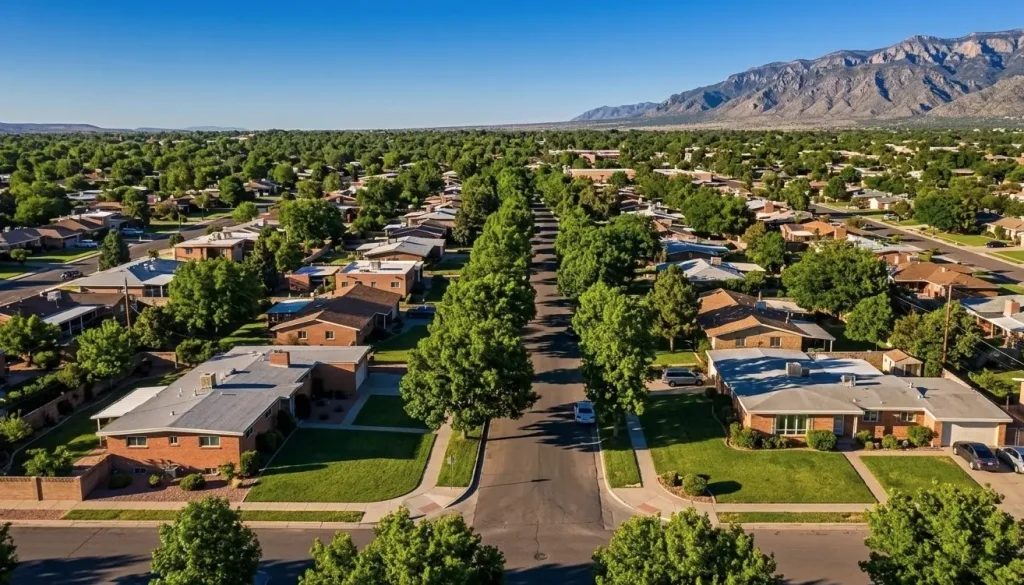
Northeast Heights: ABQ’s safest large residential zone. Neighborhoods from Hoffmantown east to the foothills and from Academy Hills north to Sandia Heights consistently post the lowest crime rates in the city for both property and violent crime. The combination of established homeownership, active neighborhood associations, and geographic positioning away from the city’s highest-crime corridors all contribute. Auto theft still occurs here — it occurs everywhere in ABQ — but at rates meaningfully below the city average.
Westside / Rio Rancho: The planned communities of the Westside — Ventana Ranch, Taylor Ranch, Paradise Hills — post crime rates at or below Northeast Heights levels for most categories. Rio Rancho proper posts some of the lowest crime rates in the metro area — a genuine, data-supported advantage that is part of the city’s appeal to family buyers.
North Valley / Corrales / Los Ranchos: Low crime, established residential character, minimal commercial activity that attracts crime. These areas benefit from geographic separation from the city’s highest-crime zones and from high homeownership rates that correlate with community stability.
Nob Hill / UNM Area: Nob Hill and the area immediately surrounding UNM have higher property crime than the Northeast Heights — partly due to the commercial activity that attracts opportunistic property crime, and partly due to the transient population associated with a major university. Violent crime is not particularly elevated for residents; property crime (vehicle break-ins, theft from commercial areas) is above average. The risk profile is typical of urban commercial districts rather than residential danger.
Downtown / EDo: Downtown ABQ is in the middle of a long revitalization. Crime here is more variable — pockets of the Downtown core have ongoing issues, while the EDo (East Downtown) corridor and areas near the Rail Trail are significantly improved. Research at the block level matters here more than in any other part of the city.
Central Corridor and South Valley: The Central Avenue corridor from the Rio Grande east to UNM and the South Valley account for a disproportionate share of ABQ’s crime statistics. These are the areas where city-wide averages are being driven. Residential neighborhoods immediately adjacent to this corridor vary significantly — some are stable and reasonably safe; others are more challenging.
Property Crime vs. Violent Crime: A Critical Distinction
ABQ’s crime challenge is primarily a property crime challenge — auto theft, vehicle break-ins, and residential burglary — rather than a violent crime challenge in most residential neighborhoods. This distinction matters for how you think about safety as a homeowner. Property crime is annoying, costly, and emotionally taxing; it is also largely mitigable through reasonable precautions (secure parking, proper lighting, good locks, alarm systems). Violent crime concentrated in specific corridors is a different category of concern.
For families making housing decisions, the practical implication is: in ABQ’s established residential neighborhoods, you’re managing property crime risk at above-average rates, not meaningfully elevated personal safety risk. Lock your car, use your garage, don’t leave valuables visible, and your experience will likely be unremarkable. This is not the case in the highest-crime corridors, where the calculus is different.
Where to Find the Data
The Albuquerque Police Department publishes crime data through the city’s open data portal (cabq.gov). The data is searchable by neighborhood and crime type, updated regularly, and is the most accurate source for neighborhood-level analysis. National platforms like NeighborhoodScout and CrimeGrade aggregate and visualize this data in user-friendly formats — useful for comparisons, though they can lag the most current APD data by months.
When comparing neighborhoods, look at incident counts relative to population, not just raw numbers. A neighborhood with 10,000 residents and 50 burglaries has a different risk profile than a neighborhood with 2,000 residents and 50 burglaries. The rate matters; the raw count is misleading without context.
Final Thoughts
Albuquerque’s crime reputation is more nuanced than the national headlines suggest and more real than boosters sometimes acknowledge. The honest picture: the Northeast Heights, Westside master-planned communities, Rio Rancho, and the semi-rural areas north of the city are genuinely safe residential environments with crime profiles comparable to mid-size cities nationwide. Central and south ABQ corridors have real elevated-risk areas that buyers should investigate carefully. The data is publicly available and specific enough to be useful — use it, and use it at the neighborhood and block level rather than the city level. Sherlock Homes NM’s neighborhood guides address safety context for each area we cover.